
AI coding assistants like Claude Code and Cursor help teams move faster on code. Tero complements that work by bringing AI agents into testing, functional analysis, software quality, and organizational adoption.
Does It Make Sense to Use Tero If Your Team Already Uses Claude Code or Cursor?
If your team already uses Claude Code, Cursor, or other AI coding assistants, it is natural to wonder whether it makes sense to add another tool to the stack. It’s not always a replacement decision. Sometimes, it’s about complementing what is already in place to achieve a better understanding of the system and make better decisions.
Tero can complement what the team already uses and extend AI adoption into quality and delivery workflows that also need context, traceability, and collaboration.
In this article, we’ll look at what makes Tero different from coding assistance tools like Claude Code or Cursor, why it is better not to think of them as competitors, and how they can coexist within the same AI strategy.
We will also analyze the value of Tero for testers, functional analysts, and quality teams, with a focus on collaboration, security, and technological independence, with visibility into the progress of platform adoption.
Want to See How Tero Can Integrate into Your Team’s Real Workflows? Contact us to explore how to bring AI agents into testing, functional analysis, and software quality.
Summary: Why Tero Complements Claude Code and Cursor
Claude Code and Cursor mainly help with code-related tasks: understanding codebases, editing files, assisting with technical changes, and accelerating development workflows. Tero plays a different role. It is designed so functional analysts, testers, QA leads, and quality teams can also work with specialized AI agents, reuse specific knowledge, and collaborate in a more governed way.
Tero was born from the experience Abstracta has built over almost 20 years solving real software quality challenges. In its open source version, that experience is reflected in a framework designed to connect system context, source code, navigation, testing, and functional analysis.
When Tero is integrated as part of Abstracta Intelligence, that potential expands with specialized agents, governance, expert support, and capabilities designed for enterprise environments.
That combination allows Tero to strongly complement a strategy where development and testing teams already work with tools like Claude Code or Cursor. While coding assistants help teams move forward on technical tasks, Tero extends AI into testing and functional analysis practices, as well as cross-functional capabilities such as team collaboration, knowledge management, security, controlled deployment, and technological independence.
What Claude Code and Cursor Do in the Development Workflow
Claude Code and Cursor are AI coding assistants designed for working with code. They help development teams understand codebases, propose changes, review implementations, and move forward on technical tasks within the development workflow.
In teams that work with complex code repositories, these tools add value in code creation from scratch, refactoring, test generation, technical documentation, change review, and project navigation. They also reduce friction in repetitive tasks or tasks with a high contextual load.
Their role in an AI strategy for software is clear: they support the people who write, maintain, and evolve code. That role is important because it accelerates part of the technical work and improves interaction with existing systems.
What Problem Tero Solves in Software Quality
Tero brings AI agents into software quality practices that involve testers, functional analysts, QA leads, and teams close to the business.
Its focus is transforming the project’s real context into a working foundation for specialized agents. That context includes requirements, user stories, acceptance criteria, functional documentation, defects, business rules, evidence, environments, team decisions, and signals that help explain what is happening behind the system.
In organizations with complex software, this information is usually distributed across tools, documents, conversations, and workflows. Tero helps prevent that knowledge from remaining isolated in people, tickets, or scattered files, making it available for analysis, validation, and better quality decisions.
| Team Need | How Tero Helps | Why It Matters for Enterprise Teams |
|---|---|---|
| Understand complex systems | Connects functional, technical, and business context so agents can work with relevant information | Reduces dependency on tribal knowledge and helps teams understand what is happening behind the visible behavior of the system |
| Review requirements and business rules | Helps analyze user stories, acceptance criteria, functional rules, and expected scenarios | Improves clarity before building or validating critical functionality |
| Design tests with context | Assists in identifying scenarios, functional risks, test cases, and boundary conditions | Helps prioritize what to validate based on risk, impact, and expected behavior |
| Integrate into real workflows | Works with information that is already part of the team’s process, such as tickets, documentation, evidence, tests, and project decisions | Connects agents with the existing stack and makes adoption easier in daily work |
| Reuse expert knowledge | Makes it possible to centralize agents, practices, prompts, policies, and strategies created by more experienced profiles | Scales quality judgment without depending on individual interventions all the time |
| Collaborate across quality, development, and business | Offers a shared foundation for analyzing requirements, risks, tests, and expected behaviors | Aligns different roles around what is validated, why it matters, and what evidence supports each decision |
| Understand complex systems | Enables more consistent use of specialized agents in testing and functional analysis tasks | Helps AI adoption move forward with shared practices, control, and a focus on impact |
AI adoption in quality needs context, expert judgment, and connection with the team’s real processes. Tero brings these elements together in a layer of agents oriented toward functional analysis, testing, knowledge management, and quality decisions.
This way, AI is not limited to code, but it also supports key tasks in the quality cycle: understanding what’s being built, how the system behaves, which risks should be prioritized, what evidence is missing, and what team knowledge should be available to everyone.
How Tero Centralizes Knowledge and Collaboration in Quality Teams
As AI use grows within a team, the need to organize practices, criteria, and learnings also grows. Tero makes it possible to make agents, policies, and AI usage strategies available in a centralized way, so expert knowledge can be reused across different projects and teams.
This is especially useful in software quality, where more experienced profiles often have valuable judgment around risks, coverage, functional analysis, behavior validation, and business priorities. With Tero, that knowledge can become shared agents, guidelines, and practices.
In practice, this makes it possible to:
- Share specialized agents for quality tasks.
- Promote AI usage policies aligned with the team’s standards.
- Reuse prompts, criteria, and strategies created by expert profiles.
- Facilitate collaboration among QA, development, product, and business.
- Give knowledge greater continuity across projects.
This point is key for enterprise teams. As AI use increases, the need for consistency, governance, and traceability also grows. Tero provides a way to organize that adoption from the real work of quality, with shared practices, reusable knowledge, and greater continuity across projects.
Security and Control for AI Agents in Testing
The information handled in testing is often sensitive: business rules, not-yet-launched functionality that may become a differentiator and therefore must remain confidential, bugs, existing vulnerabilities, and more. This information can affect security, operations, or a competitive advantage.
At Abstracta, we support different teams going through these challenges, especially in the financial sector. That’s why we designed Tero to respond to these needs. Tero makes it possible to incorporate AI agents with greater control over security and governance.
Its model is open source and auditable. This makes it possible to:
- Review and audit how the platform works.
- Adapt the platform to internal policies and deploy it in controlled environments.
- Deploy AI agents on on-premise infrastructure or in a private cloud, depending on security, governance, and compliance needs.
- Work with commercial or open source LLM models.
- Use different cloud environments, such as Azure, AWS, or GCP.
- Reduce dependency on a single AI provider, LLM model, or cloud environment, one of the most common risks of vendor lock-in.
- Align the use of agents with internal security and data policies.
This flexibility helps integrate AI into real workflows without separating agents from the existing stack or from the team’s governance criteria. For teams working with critical systems, sensitive data, or regulatory restrictions, Tero offers a more controlled foundation for scaling AI agents in software quality.
Abstracta Intelligence: Expert Knowledge and Organizational Adoption
Tero, in its enterprise version, is part of a broader vision for AI adoption in software quality: Abstracta Intelligence. This layer combines agents integrated into the existing stack, real workflows, Abstracta’s expert knowledge from almost 20 years of experience, and support for incorporating AI into the team’s processes.
That knowledge translates into agents, tools, and practices designed to solve real quality tasks: connecting system context, accessing source code information, executing actions in browsers, supporting testing, assisting functional analysis, and making technical information available to teams involved in quality decisions, from QA and development to product and business.
In addition, Tero evolves alongside technology: new models, new agent capabilities, and new ways to integrate AI into quality workflows. This allows teams to focus on their processes, their digital product, and their business decisions, with an AI foundation maintained through Abstracta’s experience.
Why Tero Makes Sense If Your Team Already Uses Coding Assistants
Tero makes sense even in teams that already use Claude Code, Cursor, or other coding assistants because it plays a different role within the AI strategy.
1. Complementarity: While the development team uses Claude Code to move forward on code-related tasks, Tero allows testers, functional analysts, QA leads, and quality teams to also incorporate AI agents into their daily work, without using a development IDE or installing local tools, through a more accessible low-code approach.
2. Cost Efficiency: Tero helps manage AI agents with greater control over costs, token consumption, and usage by team. It makes it possible to define quotas, centralize administration, and visualize how models are used across different workflows. This allows organizations to scale AI adoption with more efficiency and better traceability.
3. Adaptation to Specific Needs: Tero enables a much more specific use of agents for specific quality and analysis tasks that cannot be solved with a coding assistant alone.
Tero expands AI adoption toward the full software quality cycle, with a secure and collaborative platform and specialized agents for roles, practices, and decisions that are not covered by individual tools.
Conclusion: Tero Brings AI into the Full Quality Cycle
Tero complements Claude Code, Cursor, and other coding assistants by extending AI into testing, functional analysis, and software quality.
Its value lies in combining specialized agents, expert knowledge, collaboration, security, flexible deployment, and technological independence within an organizational adoption strategy.
For teams that already use coding assistants, Tero adds a quality-oriented layer: it helps teams better understand the system, prioritize risks, reuse knowledge, and make better decisions about what to validate and how to improve the digital product.
About Abstracta
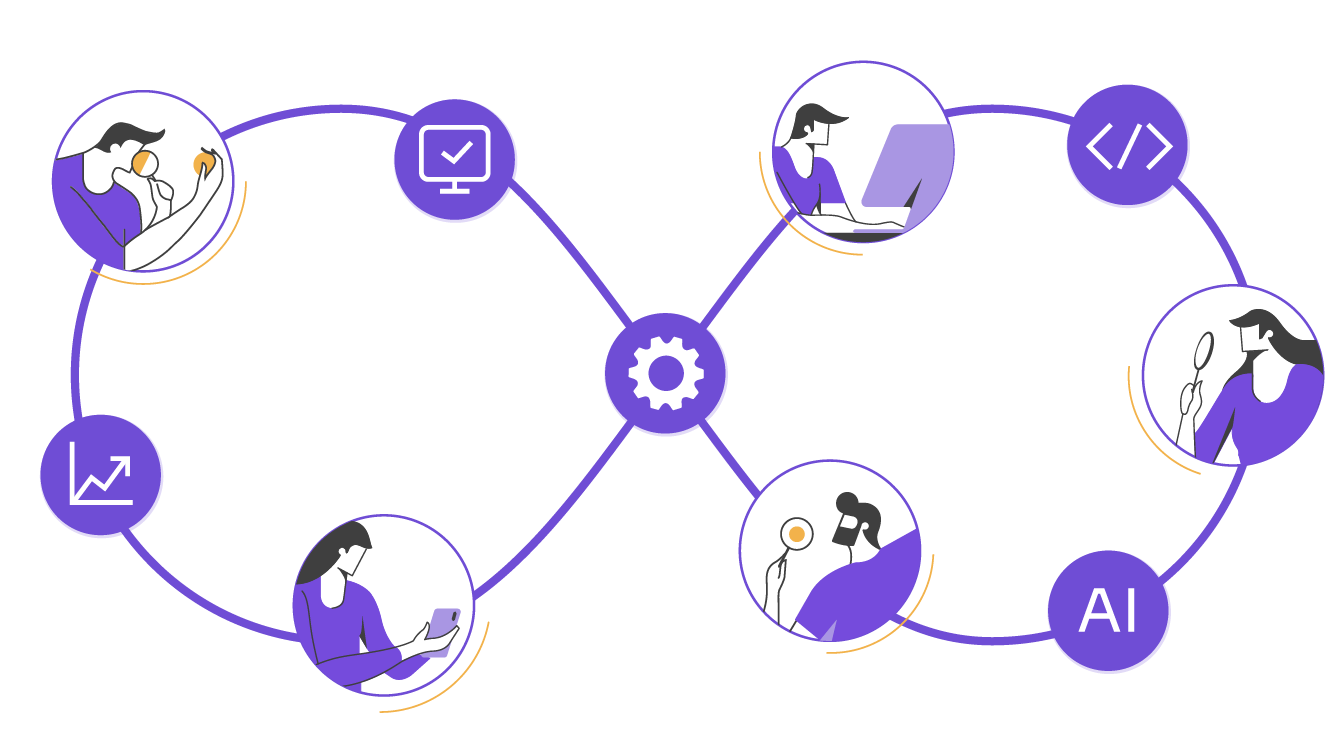
With nearly 2 decades of experience and a global presence, Abstracta is a technology company that helps organizations deliver high-quality software faster by combining AI-powered quality engineering with deep human expertise.
Our expertise spans across industries and complex delivery environments. That’s why we’ve built robust partnerships with industry leaders, such as Microsoft, Datadog, Tricentis, Perforce BlazeMeter, Sauce Labs, and PractiTest.
Explore our solutions or contact us to talk about how to bring AI into the software quality cycle.

Follow us on LinkedIn & X to be part of our community!
Recommended for You
AI Can Migrate Code. Who Validates That the Business Still Works?
21 QA Metrics Every High-Performing Software Team Should Track

 Abstracta


